
Friday, October 2, 2009
Generally speaking, you know what bothers me about puritans? They entice you with promises of non-alcoholic glee, and then once you've joined their cult they tell you what you're going to do-- nothing fun, that's what. They make you go to your hovel and wear grey dresses. Especially if you're a little boy. Nothing says puritanical like little boys in grey dresses. That's what the Oft Quoted Puritan says, anyway.

Wednesday, September 30, 2009
and i can't deny it
this morning.... i stayed up all night long. i know i'll crash at about 4pm today, but that's okay. point is, i have books, coffee (in a huge alice in wonderland mug), a nice window, an empty apartment, and frank sinatra singing "that's life" in my ear. i love this moment. i love this moment. i love this moment.
flattery
An actress flattered me yesterday by saying she thought I was a fellow actress while we were doing a read-through. This made me happy.
Sunday, September 27, 2009
from an email i wrote to a newish friend
I remember the insignificantly significant. I remember the exact first words Josh Nitschke and I exchanged ("Is that the room? They all look alike!"), what I was wearing when I met Jon (a large lampshade hat, which i was really trying to make work that day, but had come to realize in the hour beforehand that it was not to be, something that his expression told me instantly. thanks, could have saved me alot of trouble). I remember my friend's friends names better than I do my classmates, I connect songs to every event and personage in my life, I collect the ticks and inflections of other people. I think it's because I am saving them up to use someday, maybe just in writing, maybe not. Sometimes I feel like JSF, a collector. Now that I have romanticised myself, I will say that I am also brazen and notorious for sharing things that folk honestly don't care about or don't feel is appropriate unless under influence of alcohol. Though I have never been drunk I would assume that were I to be, I would be the best friend that the main character would not want around because I would tell so-and-so that so-and-so likes him, and so on.
-----
Forgive this, but my cat has nine lives (i do not tire of finding that amusing): what sort of gesture did you choose to represent yourself? I hate those kinds of things. Not expression, but having to encapsulate yourself, say something about yourself. It seems like on the one hand if you knew yourself you wouldn't be able to summarize at all because it's too great, then again if you knew yourself utterly you would know the one word, the one gesture that could be you, tastes and preferences aside and be damned with only the core remaining. And if you knew yourself you'd be okay with that. Whereas I, though I like to think I know myself so much better than other people, feel like I have to demonstrate my layers or duality or so many elements of my identity (as I would like it to be) constantly. In summary, those kinds of things give me too much personal anxiety-- as if by saying the word or making the motion I am sentencing myself to be that, rather than letting that speak for me. Ah well.
-----
Forgive this, but my cat has nine lives (i do not tire of finding that amusing): what sort of gesture did you choose to represent yourself? I hate those kinds of things. Not expression, but having to encapsulate yourself, say something about yourself. It seems like on the one hand if you knew yourself you wouldn't be able to summarize at all because it's too great, then again if you knew yourself utterly you would know the one word, the one gesture that could be you, tastes and preferences aside and be damned with only the core remaining. And if you knew yourself you'd be okay with that. Whereas I, though I like to think I know myself so much better than other people, feel like I have to demonstrate my layers or duality or so many elements of my identity (as I would like it to be) constantly. In summary, those kinds of things give me too much personal anxiety-- as if by saying the word or making the motion I am sentencing myself to be that, rather than letting that speak for me. Ah well.
Saturday, September 26, 2009
is this really three in one?
that's what she said.
Anyway. My room is mostly decorated, and mostly clean (on my side) right now. I went grocerey shopping today; I returned stuff. Much better day than yesterday, which was just a huge disaster on a massive scale-- one of those days that worries me for my future self. If I don't escape from the scrapes that I am continually putting myself into then I fear they will only get worse, but that is not what I feel like thinking about right now.
One of my favorite songs about pain is John Lennon's "God", which doesn't get talked about all that much, except sometimes by the chapman guy who shot him. Sometimes I think about how Lennon died and I'm just surprised-- really, that someone that iconic was taken down by a chubby weirdo who now seems to be a form of Alex DeLarge, that he never escaped from Yoko (was it better that way?). I've read so much about John Lennon in the past three or four years that I have a strange sense about him-- you know how no matter what you always seem to have a feeling about some celebrity or other?-- I get this sense of tragedy to match his wit. He was so brilliant but so self-loathing, so wanting someone to take care of him. How else could you explain a genius being in the situations he was in at various times? He seemed far superior to the other Beatle-minds, and way too intelligent to be taken in by people like Yoko or sexy sadie or what have you? What a restless mind. He wanted to be taken in, he wanted everything that sounded ridiculous and fantastic to be true, but everytime he came up empty he'd berate the beauty of the attraction in the first place, he'd chastise what he viewed as sirens for pulling him in, when really he was the one listening, willing to listen to them every single time.
that was a totally off-base stream of conciousness and not at all what i wanted to write about, but the song came on and it gave me that feeling it always does. i can't believe songwriters die. good songwriters-- good writers-- good musicians-- good artists-- should simply deny others the crown and live forever. it's not right taht artists should die. it's just not. how on earth can we connect so often to someone who no longer breathes? and yet we do. i think it has something to do with the soul, however you wish to interpret that.
anyways.
So I have to write a short paper thingy about Plato's views on art and aesthetics, and while I understood (and relished) the reading I have no idea where to go with that. I'm going to stream of conciousness here.
So Plato says:
- Art is imitation
- Art is the lowest form of a "thing", the 3rd version of it (it's natural state, its tangible state, and then... art)
- Art is either useless because it has no social utility OR
- Art is falsifying, appealing to the lowest part of the soul, because it may incite a distorted view or bad behavior as a result of misunderstanding.
- A: it may incite a distorted view for the less educated because we are fooled into thinking we are being educated but rather we are just enjoying diversions. Because storytellers, artists, imitate without knowing the natural or tangible state of the thing that they are imitating, they may be presenting something entirely false, or at least somewhat "angled"-- as in a painting of a bed. depending on the angle at which the bed is painted, the perspective of the bed will appear to change, but that is not necessarily what a real-life bed really IS. Then, later, when we see a bed, we may not recognize it or think it to be something else. The same can be said of virtue, beauty, good things and bad things (don't do bad things, only do good things...)
- B: It may arouse in us passion, but passion isn't beneficial. it makes us behave rashly.
this is kind of confusing, because he essentially calls it evil.
then he goes on in Ion to talk about how it can be divine, from the gods, which is funny because according to plato nothing from the gods could be bad-- in fact, if it is inspired-- created? by the gods does that mean it is a new "thing", a "thing" all to itself? Ie, the first manifestation of something natural rather than the third version of something; a pure imitation? And Plato doesn't say this specifically, but one would reason that aside from imitation there IS creation in art, even then, obviously-- but because of its invention is it then a lie and therefore evil? OR woulc he argue that there actually is nothing new under the sun, there cannot be creation outside of what the gods have already created-- everything, therefore, is imitation of their natural creations??
Bottom line (2): Art is imitation and therefore bad. Artists are imitators of the lowest form and therefore know nothing except how to imitate.
Obviously, I have alot of objections to this approach, but not none that can be approached using the constructs that Plato has arranged. He promotes censorship; but to achieve his ends of an ideal city full of obidient people, people of one mind, one cannot deny that his approach is fairly sound. Most other objections are rooted in the idea that passion is healthy and good, and not just rash and dangerous, as Plato asserts at every given moment.
I suppose my major objection to Plato's declaration that art is "bad" is this: Plato says passion isn't beneficial, and passion can be a result of art. To me, it seems as though being exposed to living passionately is a large part of being human- human in a POSITIVE sense rather than a reckless and useless way. Plato's approach to life seems to center around virtue, which is noble and true, but he assumes that passion has nothing to do with virtue. Can not one be passionate about virtue?
One thing I may say is that a writer or painter may know his procedure-- his craft being how to wield a pen or brush, and, while it's true that if a writer wrote about surgeons that he is imitating what he may vaguely understand or have researched-- but I would argue that an artist- a good artist, at least- does have a skill of understanding and insight. From my perspective, Plato sort of fears humanity-- he wants to educate it and put it away, reason it into civility, but in doing that isn't he also trying to understand it, to analyze it and to improve it? Is he not making observations about men and trying to make sense of them? Isn't that what all good art does? Is not art, in a sense, philosophy? And in that case, isn't an artist, depicting his understanding of humanity with his own personal insight, putting forth a concept just as Plato does in his dialogues? It is arguable that the artist draws no conclusions, but according to Plato who declares that art can alter opinion via emotion art DOES put forth a statement (ie a tragedy-- this is sad, or a frightening painting-- this is scary), just like Plato's philosophy (ie philosophy of aesthetics-- art is bad. art can be dangerous). I suggest that artists are philosophers too, albeit with a more emotional approach (which, yes, Plato would condemn most of the time for being passionate-- but then again he does seem to agree that emotion may be Divine), and therefore possess knowledge similiar to that of a philosopher-- it is simply expressed differently.
Anyway. My room is mostly decorated, and mostly clean (on my side) right now. I went grocerey shopping today; I returned stuff. Much better day than yesterday, which was just a huge disaster on a massive scale-- one of those days that worries me for my future self. If I don't escape from the scrapes that I am continually putting myself into then I fear they will only get worse, but that is not what I feel like thinking about right now.
One of my favorite songs about pain is John Lennon's "God", which doesn't get talked about all that much, except sometimes by the chapman guy who shot him. Sometimes I think about how Lennon died and I'm just surprised-- really, that someone that iconic was taken down by a chubby weirdo who now seems to be a form of Alex DeLarge, that he never escaped from Yoko (was it better that way?). I've read so much about John Lennon in the past three or four years that I have a strange sense about him-- you know how no matter what you always seem to have a feeling about some celebrity or other?-- I get this sense of tragedy to match his wit. He was so brilliant but so self-loathing, so wanting someone to take care of him. How else could you explain a genius being in the situations he was in at various times? He seemed far superior to the other Beatle-minds, and way too intelligent to be taken in by people like Yoko or sexy sadie or what have you? What a restless mind. He wanted to be taken in, he wanted everything that sounded ridiculous and fantastic to be true, but everytime he came up empty he'd berate the beauty of the attraction in the first place, he'd chastise what he viewed as sirens for pulling him in, when really he was the one listening, willing to listen to them every single time.
that was a totally off-base stream of conciousness and not at all what i wanted to write about, but the song came on and it gave me that feeling it always does. i can't believe songwriters die. good songwriters-- good writers-- good musicians-- good artists-- should simply deny others the crown and live forever. it's not right taht artists should die. it's just not. how on earth can we connect so often to someone who no longer breathes? and yet we do. i think it has something to do with the soul, however you wish to interpret that.
anyways.
So I have to write a short paper thingy about Plato's views on art and aesthetics, and while I understood (and relished) the reading I have no idea where to go with that. I'm going to stream of conciousness here.
So Plato says:
- Art is imitation
- Art is the lowest form of a "thing", the 3rd version of it (it's natural state, its tangible state, and then... art)
- Art is either useless because it has no social utility OR
- Art is falsifying, appealing to the lowest part of the soul, because it may incite a distorted view or bad behavior as a result of misunderstanding.
- A: it may incite a distorted view for the less educated because we are fooled into thinking we are being educated but rather we are just enjoying diversions. Because storytellers, artists, imitate without knowing the natural or tangible state of the thing that they are imitating, they may be presenting something entirely false, or at least somewhat "angled"-- as in a painting of a bed. depending on the angle at which the bed is painted, the perspective of the bed will appear to change, but that is not necessarily what a real-life bed really IS. Then, later, when we see a bed, we may not recognize it or think it to be something else. The same can be said of virtue, beauty, good things and bad things (don't do bad things, only do good things...)
- B: It may arouse in us passion, but passion isn't beneficial. it makes us behave rashly.
this is kind of confusing, because he essentially calls it evil.
then he goes on in Ion to talk about how it can be divine, from the gods, which is funny because according to plato nothing from the gods could be bad-- in fact, if it is inspired-- created? by the gods does that mean it is a new "thing", a "thing" all to itself? Ie, the first manifestation of something natural rather than the third version of something; a pure imitation? And Plato doesn't say this specifically, but one would reason that aside from imitation there IS creation in art, even then, obviously-- but because of its invention is it then a lie and therefore evil? OR woulc he argue that there actually is nothing new under the sun, there cannot be creation outside of what the gods have already created-- everything, therefore, is imitation of their natural creations??
Bottom line (2): Art is imitation and therefore bad. Artists are imitators of the lowest form and therefore know nothing except how to imitate.
Obviously, I have alot of objections to this approach, but not none that can be approached using the constructs that Plato has arranged. He promotes censorship; but to achieve his ends of an ideal city full of obidient people, people of one mind, one cannot deny that his approach is fairly sound. Most other objections are rooted in the idea that passion is healthy and good, and not just rash and dangerous, as Plato asserts at every given moment.
I suppose my major objection to Plato's declaration that art is "bad" is this: Plato says passion isn't beneficial, and passion can be a result of art. To me, it seems as though being exposed to living passionately is a large part of being human- human in a POSITIVE sense rather than a reckless and useless way. Plato's approach to life seems to center around virtue, which is noble and true, but he assumes that passion has nothing to do with virtue. Can not one be passionate about virtue?
One thing I may say is that a writer or painter may know his procedure-- his craft being how to wield a pen or brush, and, while it's true that if a writer wrote about surgeons that he is imitating what he may vaguely understand or have researched-- but I would argue that an artist- a good artist, at least- does have a skill of understanding and insight. From my perspective, Plato sort of fears humanity-- he wants to educate it and put it away, reason it into civility, but in doing that isn't he also trying to understand it, to analyze it and to improve it? Is he not making observations about men and trying to make sense of them? Isn't that what all good art does? Is not art, in a sense, philosophy? And in that case, isn't an artist, depicting his understanding of humanity with his own personal insight, putting forth a concept just as Plato does in his dialogues? It is arguable that the artist draws no conclusions, but according to Plato who declares that art can alter opinion via emotion art DOES put forth a statement (ie a tragedy-- this is sad, or a frightening painting-- this is scary), just like Plato's philosophy (ie philosophy of aesthetics-- art is bad. art can be dangerous). I suggest that artists are philosophers too, albeit with a more emotional approach (which, yes, Plato would condemn most of the time for being passionate-- but then again he does seem to agree that emotion may be Divine), and therefore possess knowledge similiar to that of a philosopher-- it is simply expressed differently.
Friday, September 25, 2009
thanks.
To the guy who approached me today in the bookstore and told me i was really cute, thank you. the self-pitying girl needed that. i hope you didn't let the self-important laugh or the awkward avoidance on the way out fool you.
oh you darling man,
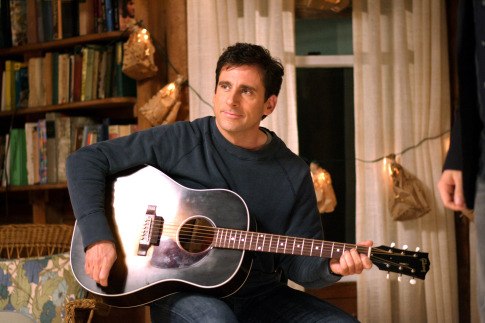
So I don't know if it's reflecting back on Dan In Real Life or one too many viewings of The Office, but I find myself irresistibly attracted to Steve Carell. I think it's just getting older and seeing the value in character (we're not talking michael scott now) and humor and gentility, all of which he appears to be in possession of. This makes him exceedingly cute.
Subscribe to:
Posts (Atom)